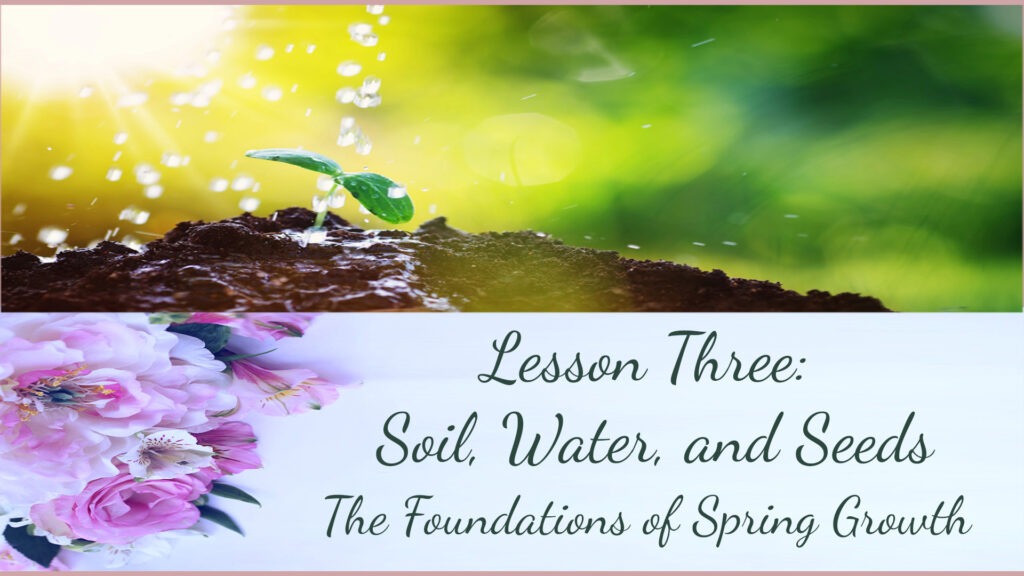
Season: Spring
Theme: soil, water, and seeds
Ages: Lower Elementary through Adult
Purpose of the Lesson
In lesson two, we covered how sunlight causes biological processes like photosynthesis. In this lesson, we are going to talk about what happens in the soil that causes plants to grow. We’re also going to cover the importance of freshwater systems and what happens within a plant’s seed. This lesson will introduce concepts like decomposition, weathering, evaporation, and condensation.
Disclaimer: This blog is for educational purposes only; I’m not a professional educator, just a nerd sharing what I’ve learned.
Learning Objectives & Outcomes
By the end of this lesson, learners will be able to:
- Explain how soil forms through weathering and decomposition
- Identify the basic components of healthy soil, including minerals, organic matter, and microorganisms
- Describe the basic structure of a seed and what it contains
- Explain how germination begins and how roots and stems develop
- Understand the basic processes of the water cycle: evaporation, condensation, and precipitation
- Identify how snowmelt, rivers, and groundwater help supply water to plants and ecosystems
Core Lesson: The Foundations of Growth
In the previous lesson, we learned that sunlight provides the energy that powers life on Earth. Plants use that energy through photosynthesis to grow. But sunlight alone is not enough. Plants also need soil, water, and seeds in order to grow and reproduce. These three systems work together to support plant life and make ecosystems possible.
Spring is the season when these systems become especially visible. Snow melts, water flows through rivers and soil, seeds sprout, and plants start growing again. Understanding soil, water, and seeds helps us understand how life renews itself each year.

Soil Formation: Where Plants Begin
You may think that soil is just dirt, but it is actually a complex and living system. Soil forms slowly over long periods of time through a process called weathering.
Weathering is the chemical or physical breakdown of rocks and minerals at the Earth’s surface. This can happen in several ways:
- Physical weathering: This is when rocks crack because of temperature changes, wind, or ice.
- Chemical weathering: This happens when minerals inside rocks react with water or air.
- Biological weathering: Happens when plant roots or organisms break apart rock.
As rocks break down, tiny mineral particles accumulate. Over time, these particles mix with organic material from dead plants and animals.

Decomposition and Nutrient Cycles
When plants, leaves, insects, and animals die, they do not simply disappear. Instead, they are broken down by decomposers such as bacteria, fungi, and insects. This process is called decomposition.
During decomposition:
- Organic material breaks down into simpler nutrients
- Those nutrients return to the soil
- Plants absorb these nutrients through their roots
This process forms part of a nutrient cycle, where nutrients move through soil, plants, animals, and microorganisms.
Without decomposition, nutrients would become locked inside dead material and could not be reused. Healthy soil depends on these natural recycling systems.
Why Healthy Soil Is Important
Healthy soil supports plant growth in several important ways.
First, soil provides the minerals and nutrients that plants need to grow. These include nitrogen, phosphorus, potassium, and other essential elements.
Second, soil stores water. Plant roots absorb this water along with dissolved nutrients.
Third, soil provides structure and stability. Roots anchor plants into the ground, allowing them to grow upward toward sunlight.
Healthy soil also contains countless living organisms. Microorganisms, worms, and insects all help maintain soil health by breaking down organic matter and improving soil structure.
Soil acts as the foundation of the entire food system. Nearly all plant-based food begins with healthy soil.

What Is Inside a Seed?
Seeds are one of nature’s most efficient ways of reproducing plants. Inside every seed is a tiny plant embryo waiting for the right conditions to grow.
Most seeds contain three main parts:
- The embryo: the young plant itself
- Stored food: nutrients that feed the embryo as it grows
- The seed coat: a protective outer layer that shields the embryo
Seeds can remain dormant for long periods of time. Some seeds wait months or even years until conditions are right for growth.
When the environment provides the right combination of moisture, temperature, and oxygen, the seed begins to grow.

Germination: The Beginning of a Plant
The process by which a seed begins to grow is called germination.
Germination begins when a seed absorbs water from the surrounding soil. This triggers chemical reactions inside the seed that activate growth.
The first structure to emerge is usually the root, called the radicle. The root grows downward into the soil, anchoring the plant and absorbing water and nutrients.
Soon after, the stem grows upward toward the surface. Once the stem reaches sunlight, leaves develop and the plant can begin photosynthesis.
This is why spring is such an important planting season. Increasing sunlight, warming soil, and abundant water create the ideal conditions for germination.

The Water Cycle: How Water Moves Through Nature
Water is another essential component of plant growth. Water constantly moves through the environment in a repeating process called the water cycle.
The water cycle includes three major processes.
Evaporation: Evaporation occurs when liquid water is heated by the sun and turns into water vapor. This vapor rises into the atmosphere.
Evaporation happens from oceans, lakes, rivers, soil, and even plant leaves.
Condensation: As water vapor rises into cooler parts of the atmosphere, it condenses. Condensation occurs when water vapor cools and forms tiny droplets that gather into clouds.
Precipitation: When water droplets in clouds grow large enough, they fall back to Earth as precipitation. Precipitation can take several forms:
- rain
- snow
- sleet
- hail
This returning water replenishes rivers, lakes, groundwater, and soil moisture.
Snowmelt, Spring Runoff, and Water Systems
In many parts of the world, winter snow plays an important role in supplying water to ecosystems.
During winter, snow accumulates in mountains and colder regions. When temperatures rise in spring, the snow melts.
This snowmelt creates spring runoff, where water flows into streams, rivers, and lakes. These rivers carry water across large areas and supply water to plants, animals, and human communities.
Some of this water also seeps into the ground and becomes groundwater. Groundwater fills underground spaces in soil and rock, forming reservoirs called aquifers.
Plants can access groundwater through their root systems, especially during dry periods.

Microorganisms and Living Soil
Healthy soil is filled with microscopic life.
Soil microorganisms include:
- Bacteria
- Fungi
- Algae
- Microscopic animals
These organisms help break down organic matter and release nutrients that plants can absorb. Some microorganisms even form partnerships with plant roots, helping plants absorb water and nutrients more efficiently.
Because of these interactions, soil is often described as a living ecosystem rather than just a collection of minerals.
Soil, Water, and Seeds Working Together
Soil, water, and seeds form a connected system that supports life. The soil provides the nutrients and structure. Water carries the nutrients that hydrate plants. Seeds contain the genetic instructions for new plant life.
When these systems work together, plants can grow, ecosystems flourish, and food systems become possible.
Understanding these natural processes helps us see why spring is such an important season for growth. As sunlight increases and water becomes available, the foundations of life, the soil, water, and seeds, begin working together again to bring the landscape back to life.
Cross-Disciplinary Connections
Soil, water, and seeds are topics within biology and the Earth sciences. But their importance covers a broad spectrum of disciplines.
Science
We learned a little about how rocks break down to form soil and how microorganisms recycle nutrients. We learned about how seeds germinate into plants and how the water cycle moves water through the environment.
Geography
Water systems shape the landscapes around the world. Rivers carve valleys, groundwater fills aquifers, and snowmen from mountains supply water to regions around them. This geography lesson covers climate, elevation, and landforms.
Agriculture and Food Systems
Food production begins with healthy soil, clean water, and viable seeds. Farming depends on nutrient-rich soil and reliable water sources to grow crops and feed the world.
History and Human Civilization
Throughout history, civilizations formed near reliable water sources and fertile soil. Rivers like the Nile, Tigris, Euphrates, Indus, and Yellow River supported early agricultural societies.
Environmental Stewardship
Studying soil, water, and seeds also encourages awareness of environmental responsibility. Healthy ecosystems depend on balanced nutrient cycles, clean water systems, and sustainable land use. Understanding how these systems function can help learners appreciate the importance of conservation, soil health, and the responsible management of natural resources.

Activities and Review Questions by Age
Lower Elementary (K–3)
Do:
- Seed Observation: Open a dry bean or pea seed and look at the inside with an adult. Draw what you see and label the parts if possible.
- Plant a Seed: Plant a bean or sunflower seed in a small pot. Water it regularly and watch for the first root and stem to appear.
- Water Cycle Drawing: Draw a simple picture showing the sun, clouds, rain, and a river to represent the water cycle.
Review:
- What do seeds grow into?
- Why do plants need water to grow?
- What happens when rain falls on the ground?
Upper Elementary
Do:
- Soil Investigation: Collect a small sample of soil and examine it. Look for rocks, roots, insects, or organic material.
- Seed Germination Experiment: Place a few seeds in a damp paper towel inside a plastic bag. Observe them each day and record when the roots start to grow.
- Water Cycle Diagram: Draw and label evaporation, condensation, and precipitation in a simple water cycle diagram.
Review:
- How does soil form from rocks and organic material?
- What part of the seed grows first during germination?
- What are the three key steps of the water cycle?
Teen / High School
Do:
- Soil Profile Study: Research the layers of soil (topsoil, subsoil, and parent material) and create a labeled diagram explaining their roles in plant growth.
- Water Source Mapping: Identify where your local water supply comes from. Is it rivers, groundwater, reservoirs, or snowmelt?
- Seed Germination Observation: Plant seeds in two different soil conditions (rich soil vs. poor soil) and compare growth over one to two weeks.
Review:
- Why is healthy soil important for agriculture and ecosystems?
- How do roots and stems develop during germination?
- How does snowmelt contribute to rivers and groundwater systems?
Adult Learners
Do:
- Soil Health Reflection: Research what makes soil healthy and evaluate the soil quality in your local area or garden.
- Water System Awareness: Identify your region’s water cycle patterns, including rainfall, snowpack, and groundwater sources.
- Seed and Food Study: Choose one crop plant (such as wheat, corn, or beans) and research how soil, water, and seeds support its growth from planting to harvest.
Review:
- Why are soil microorganisms important for nutrient cycles?
- How do soil, water, and seeds work together to support plant life?
- Why have civilizations historically developed near fertile soil and reliable water sources?
Conclusion
Soil, water, and seeds form the foundation of plant life on Earth. Soil provides nutrients and stability, while water carries those nutrients and supports growth. The seeds contain the beginnings of new plants. Together, these natural systems allow ecosystems to thrive. They also make agriculture and human life possible.
In the next lesson, we will build on this foundation by exploring the food chain and how early humans learned to use the resources they saw around them to develop from hunter-gatherer societies to civilization builders.
References