Season: Spring
Theme: light, energy, and renewal
Ages: Lower Elementary through Adult
Purpose of the Lesson
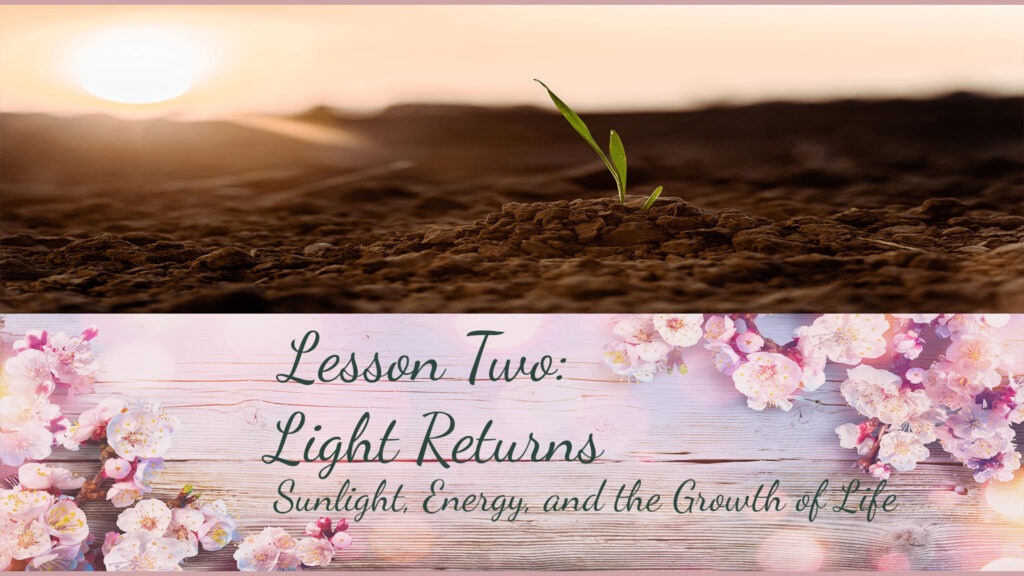
This Lesson builds on Lesson One’s understanding of seasonal cycles by focusing on light and energy as the primary driver of spring growth. Students will learn that increasing sunlight after the spring equinox powers changes in plants, animals and human bodies. Students will also learn how the seasons differ in the tropics and at the poles, and they will learn the basics of human nutrition.
Disclaimer: This blog is for educational purposes only; I’m not a professional educator, just a nerd sharing what I’ve learned.
Learning Objectives & Outcomes
In the last lesson, we learned about seasons and how the Earth’s movement around the sun causes the seasons. And we learned about how plants and animals respond to the seasons in temperate climates. In this lesson, we are going to learn more about what light is and how the sun creates light energy, which life on Earth uses.
By the end of this lesson, learners will be able to:
- Explain how increasing daylight affects life in spring
- Understand sunlight as energy
- Describe how plants use light to grow
- Identify basic ways light affects human sleep, energy, and activity
- Recognize why spring diets and routines historically differed from winter
- Understand basic human nutrition
- Understand how the sun’s light affects the tropics and the poles.
Core Lesson: How Spring Works

The Physics of the Sun: Where Light Begins
The sun is a star, just like all the other stars in the universe. When you look up into the night sky and see all those twinkling dots, what you are really seeing are massive spheres of extremely hot gas, mostly hydrogen and helium.
Our star, the Sun, appears to us as a bright disk up in the sky, but it’s actually massive. A million Earths could fit inside it. At 93 million miles away, it’s the closest star to Earth.
The sun shines because of a process happening deep within its core called nuclear fusion. This happens when tiny invisible particles called hydrogen atoms are pressed together under intense heat and pressure. When they fuse like that, they form helium. In the process of fusing together, a massive amount of energy is released and that energy travels through the sun and out into the universe as light and heat.
This light takes about 8 minutes to reach Earth. And light is energy. All life on Earth depends on the light and heat energy coming from the sun. It warms the air, heats the soil, and provides the power for plants to grow. Without it, our planet would be dark and frozen. Much like the moon.

Light and Plant Growth: Photosynthesis
Plants make use of the sun’s energy most directly. The plant’s leaves contain tiny structures called chloroplasts, and these chloroplasts contain chlorophyll. Chlorophyll gives plants their green pigment, and it helps the plant absorb sunlight. This direct absorption of sunlight by the plant is called photosynthesis.
When sunlight hits a leaf, plants use that light energy to combine water from the soil and carbon dioxide from the air to make glucose, which is a type of sugar. And that sugar becomes the plant’s food and fuel. Oxygen is released as a byproduct of this process, and oxygen is the air all animals, including humans, breathe.
So plants take the light energy that the Earth receives from the sun to make their own food.

Light and Animals
Unlike plants, animals can’t make their own food from sunlight. But they are still affected by light energy. The increasing daylight in spring triggers hormonal changes in many species. Birds migrate when daylight reaches a certain length. Mammals enter breeding cycles, and insects emerge from dormancy.
Light acts like a signal. It tells animals that warmer temperatures and greater food resources are coming. Many species time their reproduction so that their babies are born when plants are growing and insects are plentiful. This gives them the best chance of survival.

Light and Human Biology
Humans respond to light energy as well. Inside our brains, there is a small region that regulates our circadian rhythm, which is like an internal clock. When light enters our eyes, this signals the brain to reduce melatonin. The hormone that makes us sleepy. This increases alertness. Therefore, darker winter days can make you feel sluggish, and brighter days make you feel energized.
Basics of Human Nutrition
Food is our energy, our fuel. Our food sources come from both plants and animals. Plants and animals store energy, and when we eat plants and animals, we gain access to that stored energy.
The three primary energy nutrients are:
- Carbohydrates: This is quick energy
- Protein: For building and repair
- Fats: longer-lasting energy and hormone support
Historically, humans ate what was available in their environment; that means our diet changes from season to season. In Spring, humans of the past relied on eggs, dairy, early greens like spinach and micro greens, preserved meats, and stored grains.
Food systems and agriculture developed around seasonal light patterns because agriculture relies on plant growth and animal availability. And plants depend on sunlight.
How Light Affects the Rest of the Planet

In lesson one, we talked about how Earth’s orbit affects the seasons in the northern and southern hemispheres. But not all places on Earth experience spring in the same way.
In the tropics, sunlight hits the earth directly, and daylight hours remain mostly consistent year around. Instead of strong winter or summer differences, tropical regions experience wet and dry seasons. Plant growth depends more on rainfall than on light changes.
Near the poles, the top and bottom of our planet, light variation is extreme. In winter, there is very little sunlight. During certain times in winter, the sun never quite rises, and it’s dark all the time. In summer, the sun never quite sets, and the world is in constant daylight. Here, plants, animals, and humans behave a little differently.
Cross-Disciplinary Connections
This lesson shows the importance of light and energy across disciplines:
Physics & Astronomy
Nuclear fusion in the Sun’s core causes light and heat. And this light energy fuels life on Earth.
Biology
Plant growth and animal life depend on light energy from the sun.
Human biology
Circadian rhythms and the basics of human nutrition depend on plants, animals, and sunlight.
History and anthropology
How food needs fueled agricultural systems
Activities And Review Questions by Age

Lower Elementary (K–3)
Do:
- Sunlight Plant Experiment: Place one plant in sunlight and one in shade. Observe for one week. Draw changes.
- Draw the energy chain: Sun → Plant → Animal → Human. Illustrate the chain.
- Sun Journal: Go outside at the same time daily. Draw where the sun is in the sky.
Review:
- What does the sun give us?
- How do plants use sunlight?
- Why are there baby animals in spring?
Upper Elementary
Do:
- Photosynthesis Diagram: Label sunlight, water, carbon dioxide, oxygen, and glucose.
- Daylight Tracking Chart: Track sunrise/sunset times for two weeks.
- Spring Foods Research: List foods historically available in early spring.
Review:
- What is photosynthesis?
- How does light affect animal behavior?
- Why do humans often feel more energetic in spring?
Teen / High School
Do:
- Circadian Rhythm Research: Write a brief explanation of how light affects melatonin.
- Polar vs. Tropical Comparison Essay: Compare daylight patterns and how ecosystems differ.
- Food as Energy Analysis: Trace one meal back to its original energy source.
Review:
- How does nuclear fusion power life on Earth?
- Why are seasonal birth cycles evolutionarily beneficial?
- How did agriculture depend on understanding light cycles?
Adult Learners
Do:
- Seasonal Routine Reset: Adjust sleep schedule based on sunrise for one week. Journal effects.
- Nutrition Reflection: Evaluate your diet in terms of whole foods and energy balance.
- Global Light Study: Research how indigenous cultures in polar regions adapt to extreme light cycles.
Review:
- How does sunlight regulate human hormonal cycles?
- Why is food best understood as stored solar energy?
- How has light shaped civilization and agriculture?
The Light is the Beginning
Spring is not just a change in temperature; it is a change in light.
As daylight increases after the spring equinox, energy moves through the natural world again. Plants turn sunlight into growth. Animals respond with migration and breeding seasons. Humans feel the shift in sleep, mood, and motivation. Everything wakes up because light returns.
When we understand that food is stored in sunlight and that our bodies run on the same rhythms as the Earth, spring becomes more than a season; it becomes a reminder of how deeply connected life is to the Sun.
In the next lesson, we will continue following this energy and explore how it shapes the world in even more practical ways.
References: